

If you've ever spent ten minutes wrestling a comb through your kid's hair after a day at the pool, you already know the feeling. The tears. The "ow, ow, OW." That sinking realisation that the lovely afternoon at the beach has left behind a bird's nest you'll be paying for tonight.
I worked as a hairdresser for over 15 years, and I've also raised swim-mad kids of my own. So I know both sides of this. I know the chemistry of what chlorine actually does to a strand of hair, and I know what it's like to be the parent holding the detangling brush at 6pm wondering where it all went wrong. This guide pulls both together. By the end, you'll know exactly how to protect kids hair from chlorine, how to rescue salt-water tangles before they take over, and how to make post-swim hair care fast enough that everyone stays happy.
So let's get into it.
Why Pool and Beach Hair Behaves So Badly

Here's the thing most people don't realise: chlorine and salt water damage hair in completely different ways. Treating them the same is half the reason kids end up with rough, knotty, sometimes weirdly green hair.
Chlorine is a disinfectant. It does a brilliant job killing bacteria in the pool, but it isn't fussy about what else it strips on the way through. When your child dives in, chlorine pulls the natural oils right out of each strand. Those oils are what keep hair soft and flexible. Take them away and you're left with dry, porous, brittle hair, the kind that snaps and tangles at the slightest provocation.
Then there's the green... If you've got a blonde or light-haired kid who comes out of the pool looking faintly seaweed-toned, that's not the chlorine itself. It's copper. Pools often contain trace copper from pipes and algaecides, and chlorine oxidises that copper so it binds to the hair shaft. Light hair shows it; dark hair hides it. Either way, green hair from chlorine is a real thing, and it's frustratingly common.
Salt water plays a different game. It's not stripping oils so much as drawing moisture out through osmosis. Saltwater also leaves behind crystalline residue that roughs up the hair's outer layer, the cuticle. When the cuticle lifts, strands catch on each other like tiny burrs. That's your classic beach knot: the tangle that seems to materialise out of nowhere on the drive home.
So chlorine hair is mostly a dryness-and-damage problem. Beach hair is mostly a tangle-and-texture problem. Knowing which one you're dealing with changes how you treat it.
The Science Is on Your Side (and It's Simpler Than You Think)

There's solid reasoning behind every tip in this guide, and it comes down to one idea: wet hair absorbs whatever it touches.
Think of a dry sponge versus a damp one. Drop a dry sponge in water and it soaks up loads. Drop in a sponge that's already saturated and it can barely take any more. Hair works the same way. A strand that's already full of clean water has very little room left to absorb chlorinated or salty water. This single principle is the backbone of nearly everything that follows, and it's why "rinse first" is the most underrated piece of advice in swim hair care.
Cosmetic chemists and trichologists (the people who study hair and scalp health) consistently point to the cuticle as the part that matters most. When it lies flat and smooth, hair is shiny, strong, and slippery enough to resist knots. When it lifts, from chlorine, salt, sun, or rough towel-drying, everything goes downhill. Protecting the cuticle is protecting the hair. Keep that in mind and the rest is just logistics.
How to Protect Kids Hair From Chlorine: The Pre-Swim Routine
This is where the real wins happen. Most parents focus all their energy on damage control after swimming, but the smartest chlorine hair care starts before your child's toes even touch the water. A few minutes of prep saves you an hour of grief later.

Wet hair can't absorb as much chlorine.
Think of it as a shield.
A braid, bun or plaits = less tangles.
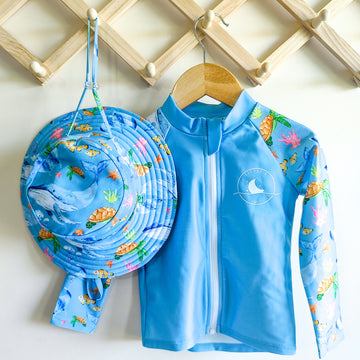
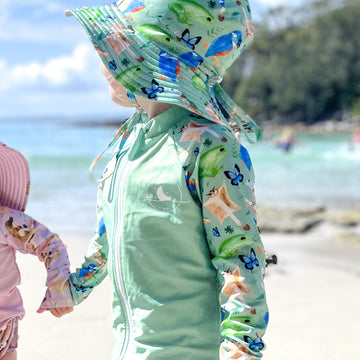
UPF 50+ hat that protects more than just skin.
Post-Swim Hair Care: The First Few Minutes Matter Most
The moment your child climbs out is the most important window in the whole process. Don't let that chlorine or salt sit and dry on the hair. As it dries, it concentrates, and concentrated residue is what does the lasting harm.
Get to a tap as soon as you can and rinse thoroughly with clean water. This flushes out the bulk of the chemicals before they have a chance to bond. A poolside shower is perfect; even a quick rinse at a beach foot-shower helps enormously with salt water hair.
When you get home, this is where a chlorine shampoo (often called a clarifying or swimmers' shampoo) earns its place. These are formulated to lift mineral buildup and chlorine residue that a regular shampoo leaves behind. You don't need it after every single swim—a few times a week for regular swimmers is plenty. Overwashing strips hair too, so there's a balance. If you're battling that green tint, a clarifying wash is your best first move for getting chlorine out of hair.
Always, always follow shampoo with conditioner. Swimming leaves hair thirsty, and hair care after swimming is mostly about putting moisture back. Focus the conditioner on the mid-lengths and ends, where damage concentrates, and leave it a minute or two before rinsing. A weekly deep mask is a lovely bonus for kids who swim a lot.
Beating the Beach Knots: A Detangling Survival Guide
Now for the tangles. If chlorine is about dryness, beach knots are about friction, and they need a slightly different approach. Learning how to detangle hair without the meltdown is a genuine parenting superpower.

This is the mistake I see constantly. Dry, tangled hair is fragile and stretchy, and forcing a brush through it just snaps strands and creates more breakage. Wet the hair first, or at least dampen it with a spray bottle. Slippery hair detangles far more easily and far more gently.
"Slip" is hairdresser-speak for slipperiness. A good conditioner or a detangling spray coats the strands so they glide past each other instead of catching. Saturate the tangled section, let it sit for a moment, and you'll feel the knots loosen before you even pick up a comb. This is the secret to how to detangle hair after swimming without the drama, and it works just as well on how to detangle kids hair generally.
Resist the instinct to brush from the scalp down. Start at the very ends and work upward in small sections. You're chasing the tangles out the bottom rather than dragging them into a bigger knot at the root. Use a wide-tooth comb or a proper detangling brush, never a fine-tooth comb on wet, knotty hair.
The best knot is the one that never happens. Braid long hair before the beach, reapply a little leave-in or hair protectant for swimming beforehand, and rinse the salt out as soon as you're done. A spritz of detangler on the drive home stops tangled hair setting in while it dries. Prevention here is genuinely easier than the cure.
"But We're Always in a Rush": Addressing the Real-World Hurdles
I'll be honest about the limitations, because no advice survives contact with a busy family if it pretends life is tidy.
The most common objection I hear is time. Who's going to rinse and braid hair when you're herding three kids and a bag of pool noodles out the door? Fair. But the pre-swim rinse takes thirty seconds, and a barrier product plus a braid adds maybe ninety more. Weigh that against an hour of detangling tears tonight, and the maths works out in your favour.
The second is the swim cap resistance. Not every child will tolerate one, and that's okay. The rinse-and-barrier routine still does most of the heavy lifting on its own. A cap is the upgrade, not the whole strategy.
And then there's the "is all this product really necessary?" question. It's a fair challenge. You don't need a cupboard full of specialist bottles. A clean-water rinse, an everyday leave-in conditioner, and a decent regular conditioner will carry the vast majority of families a very long way. The specialist chlorine shampoo and dedicated protective hair mask for swimming are genuinely useful for daily swimmers and damaged hair, but they're optional extras, not entry requirements. Spend where it counts for your situation.
Quick Reference: Your Swim Hair Care Checklist
Here's everything boiled down so you can screenshot it and go:
Before Swimming
Straight After Swimming
At Home
The Bottom Line
Look, healthy hair through a summer of nonstop swimming isn't about a pricey shelf of products or some fussy salon routine. It comes down to knowing what's actually going on with those strands, chlorine stripping the oils, salt roughing up the cuticle, and getting ahead of it with a few easy habits you can do half-asleep.
Rinse before. Pop a barrier on. Rinse after. Wash and condition like you mean it. Detangle gently. That's the whole playbook for how to protect kids hair from chlorine and keep those beach knots at bay.
So let the kids be kids. Let them bomb into the pool, muck about in the shallows, and build sandcastles till their fingers go all pruney. You'll still end up with soft, tangle-free hair at the end of the day instead of a blue at bath time. Fair trade, if you ask me. Now go on, get out there and enjoy the water.


