

When winter rolls around, sunscreen is usually the first thing to disappear from the morning routine. The beach towels are packed away. The jumpers come out. School drop offs happen under cloudy skies, and suddenly sun protection doesn't feel as urgent as it did in summer.
If you've ever wondered, do you need sunscreen in winter, you're not alone. It's one of the most common questions Australian parents ask, and it's also one of the biggest misconceptions about sun safety.
The surprising truth is that your child can still be exposed to damaging ultraviolet, UV, radiation on cool or cloudy days. In fact, across much of Australia, the UV Index regularly reaches levels where sun protection is recommended, even during winter. That means your child's skin can still experience sun damage while walking to school, playing at the park, watching weekend sport, or exploring outdoors, even if they never feel hot.
In this guide Do you need sunscreen in winter? Can you get sunburnt in winter? What does UV 3 actually mean? Do kids need sunscreen on cloudy days? UV Index in Australia during winter UVA vs UVB How to protect kids from winter UV Common myths Frequently asked questions
Do you need sunscreen in winter?
Quick answerYes. If the UV Index is 3 or above, sunscreen is recommended, regardless of the season. That's the advice from Cancer Council Australia and ARPANSA, Australia's Radiation Protection Authority.
Many people assume sunscreen is only necessary when it's hot outside. In reality, the amount of UV radiation reaching the Earth's surface is often unrelated to how warm it feels.Think of UV like electricity. You can't see it. You usually can't feel it. But it can still cause damage. Even on a crisp winter morning, UV radiation can penetrate your child's skin and begin damaging skin cells long before there's any visible redness. That's why checking the UV Index is far more important than checking the temperature.
Temperature doesn't predict UV
Imagine these two days.Day One
34°C
Hot summer afternoon
UV Index 12Clearly a day for hats, sunscreen and shade.Day Two
17°C
Bright winter sunshine
UV Index 4Still high enough to cause skin damage.Why children's skin needs extra protection
Children are naturally more vulnerable to UV exposure than adults. Their skin is thinner, more sensitive and contains less protective pigment than fully developed adult skin. Because of this, they can accumulate UV damage over time, even if it isn't immediately visible.Research has shown that much of a person's lifetime UV exposure happens during childhood and adolescence. While one cloudy winter afternoon isn't likely to cause noticeable harm, repeated exposure over months and years can increase the risk of skin damage and skin cancer later in life. Australia has one of the highest rates of skin cancer in the world, which makes everyday sun protection one of the healthiest habits parents can build from an early age.Can you get sunburnt in winter?
Absolutely. Many Australians are surprised to learn they can get sunburnt in winter, because they associate sunburn with sweating, heat and beach days. But sunburn isn't caused by heat. It's caused by UV radiation damaging skin cells.This is why people often return from a winter ski holiday with bright red cheeks, or why children can develop sunburn after spending the day at Saturday sport in the middle of July. The weather felt cold. The UV exposure was still high.A real life example
Imagine your child spends three hours watching soccer on a sunny winter morning. They're wearing a warm jumper. They're comfortable. They never complain about being hot. But the UV Index reaches 4 by late morning. Without sunscreen or a broad brim hat, their face, ears and neck are still exposed to enough UV radiation to cause skin damage. Because they never felt hot, it doesn't occur to anyone that sun protection was needed. This is exactly why so many parents accidentally skip sunscreen during winter.Why you don't always notice UV damage
One of the trickiest things about UV radiation is that you rarely feel it happening. Heat activates your body's warning system. UV doesn't. Your child's skin may already be experiencing cellular damage before there's any redness or discomfort. That's why relying on temperature or how sunny it feels isn't an accurate way to judge whether sunscreen is needed.What does UV 3 mean?
If you've ever checked the weather app and noticed a small number labelled "UV Index", you might have wondered what it actually means. More importantly, you might have asked, what UV index do you need sunscreen? The answer is simple. In Australia, sun protection is recommended whenever the UV Index reaches 3 or above.Many parents are surprised by this, because a UV Index of 3 doesn't sound particularly high. Yet it's the point where unprotected skin can begin to suffer damage.| UV Index | Risk level | Recommended protection |
|---|---|---|
| 0 to 2 | Low | Protection usually not required |
| 3 to 5 | Moderate | Sunscreen, broad brim hat, sunglasses and protective clothing |
| 6 to 7 | High | Reduce time in direct sun and use full protection |
| 8 to 10 | Very high | Extra precautions are essential |
| 11+ | Extreme | Avoid prolonged exposure where possible |
Why Australia is different
Australia experiences some of the highest UV levels in the world. That comes down to several factors working together, our location closer to the equator than many countries, clear atmospheric conditions, high sunshine levels throughout the year, and large areas with little shade.This means winter in Australia isn't the same as winter in Europe or North America. Even though temperatures drop, UV radiation often remains high enough to damage skin. So Australian parents shouldn't assume winter automatically means sunscreen isn't needed.Do you need sunscreen on a cloudy day?
Another common myth is that clouds block harmful UV rays. Unfortunately, that's not how UV works. Clouds reduce visible sunlight, but they don't necessarily block UV radiation. Light cloud can allow a large proportion of UV to pass straight through. In some situations, broken cloud can even increase UV levels briefly by reflecting sunlight around the clouds. So while the day feels gloomy, your child's skin can still be exposed. That's why you can return from a cloudy day outdoors with a sunburn you never expected."UV can be high even on cool and overcast days. You cannot rely on clear skies or high temperatures to know when to protect your skin." Cancer Council AustraliaCloudy doesn't mean protected
Picture this. It's a grey Saturday morning. Your family heads to the local playground. Everyone wears jackets because it's chilly. Since the sun isn't shining, sunscreen stays at home. By lunchtime, the clouds begin to thin. The UV Index quietly reaches 4. Your children spend another two hours outside. No one feels hot, but UV exposure continues the entire time. This is why checking the UV forecast is much more useful than simply looking outside.UV Index Australia winter
Many parents ask whether Australia's UV Index actually reaches 3 during winter. The answer depends on where you live, but across much of the country, yes, it does.Northern Australia often experiences UV levels above 3 throughout the year. Cities such as Brisbane, Perth and Darwin frequently record winter UV levels that still require sun protection during the middle of the day. Even southern cities including Sydney, Melbourne, Adelaide and Canberra regularly reach UV 3 or higher on clear winter days.This means winter shouldn't automatically change your family's sun protection habits. Instead of asking "is it cold today?", try asking "what's today's UV Index?" That one small habit can make a big difference.Why snow can make UV exposure even worse
Many families head to the snow during winter holidays expecting the cold to provide protection. Ironically, snow can increase UV exposure. Fresh snow reflects a large amount of UV radiation back towards your face, so instead of receiving UV from above only, you're also exposed to reflected UV from below. Higher elevations also have thinner atmosphere, meaning less UV is filtered before reaching your skin. This is why skiing and snow holidays often result in sunburned noses, cheeks and lips.Children spending long hours outdoors at alpine resorts should still wear SPF 50 sunscreen, a broad brim hat whenever practical, sunglasses with UV protection, and protective clothing that covers exposed skin. The cold doesn't reduce UV damage. If anything, snow can make exposure even stronger.UVA vs UVB, what's actually damaging your child's skin?
When parents shop for sunscreen, they often notice the letters UVA and UVB on the label. Understanding the difference helps explain why winter protection matters.UVB rays are responsible for causing sunburn. They're strongest during summer and around the middle of the day, and they're one of the main contributors to skin cancer.UVA rays behave differently. They remain relatively constant throughout the year, they penetrate deeper into the skin, and unlike UVB, UVA can pass through light cloud and even some window glass. That means children sitting near sunny classroom windows, riding in the car, or playing outside during winter are still exposed to UVA.Both UVA and UVB contribute to long term skin damage. That's why broad spectrum sunscreen is recommended, it protects against both types of UV radiation. It isn't winter that determines whether sunscreen is needed. It's the UV Index.How to protect kids from winter UV
Knowing that winter UV can still damage your child's skin is one thing. Putting it into practice is another. The good news is that a few simple habits make a big difference, especially when they become part of everyday life. Think of sun protection the same way you think about fastening a seatbelt. It only takes a moment, but it helps protect your child every time they head outside.1. Check the UV Index, not the temperature
Before you leave the house, take a quick look at the daily UV Index. Most weather apps display it alongside the forecast, and it only takes a few seconds. If the UV Index is 3 or above, it's time to think about sun protection. This habit is far more reliable than guessing based on how warm or sunny the day feels.2. Choose SPF 50 broad spectrum sunscreen
When the UV Index reaches 3 or above, apply a broad spectrum SPF 50 or SPF 50+ sunscreen to any exposed skin. Don't forget the spots that are often missed, including the ears, nose, neck, back of the hands, and the tops of the feet if sandals are worn. Apply it about 20 minutes before heading outdoors, then reapply every two hours, or more often after sweating or water play.3. Let UPF clothing do the heavy lifting
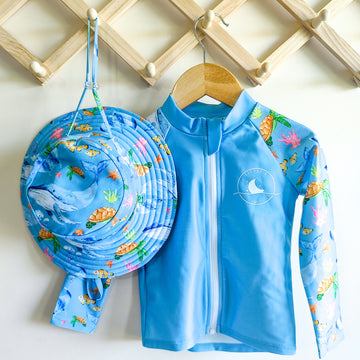
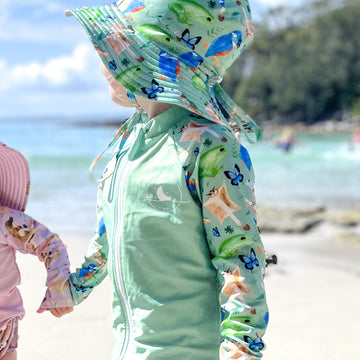
One of the easiest ways to reduce UV exposure is choosing clothing designed to block harmful rays. Unlike regular fabrics, UPF clothing is tested to measure how much UV radiation it lets through. UPF 50+ blocks at least 98 percent of UV radiation, while a regular cotton shirt varies a lot depending on colour, thickness and how stretched the fabric becomes. For active children, our UPF rashies offer consistent protection without relying entirely on sunscreen, which is ideal for beach days, swimming lessons and outdoor adventures where sunscreen wears off over time.4. Don't underestimate a broad brim hat
A cap protects the forehead. A broad brim hat protects much more. The ears, cheeks, nose and back of the neck are some of the areas most commonly affected by sun damage in children. Our reversible broad brim swim hats shade all of those areas while staying comfortable enough for everyday wear, with an adjustable, removable chin strap to keep them on little heads.5. Look for shade when possible
Shade doesn't eliminate UV exposure completely, but it does reduce it. When visiting playgrounds, parks or sporting events, choose shaded areas where possible. Trees, shelters and shade sails all help. Combining shade with sunscreen, protective clothing and hats offers much stronger protection than relying on just one method.Common winter sun safety myths
Myth: It's cold, so sunscreen isn't needed.Fact: Temperature and UV are different things. Cold weather doesn't stop UV radiation from reaching your child's skin.
Myth: Cloudy days block UV.Fact: Light cloud often lets significant UV through. Some cloudy days still record UV Index readings of 3 or higher.
Myth: My child only needs sunscreen at the beach.Fact: UV exposure happens anywhere outdoors. Walking to school, weekend sport, playground visits and picnics all add up.
Myth: One winter won't matter.Fact: Skin damage builds over time. Repeated UV exposure during childhood contributes to long term damage and raises skin cancer risk later in life.
Frequently asked questions
Do you need sunscreen in winter?
Yes. If the UV Index is 3 or above, sunscreen is recommended, regardless of the season. In many parts of Australia, winter UV regularly reaches this level.Can kids get sunburnt in winter?
Absolutely. Sunburn is caused by UV radiation, not heat. Children can still burn on cool or cloudy winter days if they're outdoors without protection.What UV Index do you need sunscreen?
Australian health authorities recommend sun protection whenever the UV Index reaches 3 or above.Do you need sunscreen on cloudy days?
Yes, if the UV Index is 3 or higher. Cloud cover doesn't necessarily block harmful UV radiation.Is sunscreen enough on its own?
Sunscreen is important, but it works best alongside other protection. A combination of SPF 50 sunscreen, UPF clothing, a broad brim hat, sunglasses and shade provides the best cover for children.Does my child need sunscreen if they're wearing long sleeves?
It depends on the clothing. Regular clothing offers varying protection, while UPF rated clothing is designed and tested to block UV. If exposed areas like the face, neck or hands are uncovered, sunscreen is still recommended when the UV Index is 3 or above.
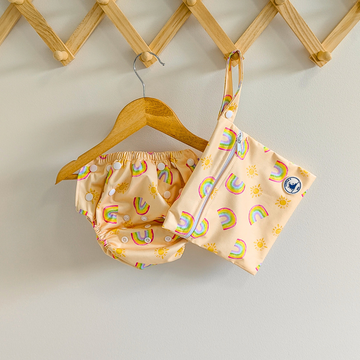
Called Home to the OceanLong sleeve rashie sets in a contemporary Indigenous ocean print.Shop the print → Community Connected to LandFour piece swim sets with rashie, hat, nappy and wet bag.Shop the print → ForestA colourful rainforest print with UPF 50+ protection built in.Shop the print → Best SellersOur most loved rashies, hats and swim sets in one place.Shop best sellers →
Winter sun safety starts with small habits
As parents, we spend so much time keeping our children warm during winter that it's easy to overlook something we can't see. UV radiation doesn't disappear when summer ends. It doesn't stop because the sky is grey. And it certainly doesn't care whether your child feels hot.That's why checking the UV Index before heading outside is one of the simplest habits you can build. It takes less than a minute and helps protect your child's skin today and well into the future.Sunshine isn't just a summer thing, and neither is sun safety ☀️At Little E & Co, from UPF 50+ swim sets to broad brim hats designed for active little explorers, our range helps Australian families enjoy the outdoors while protecting delicate skin. Every purchase gives 10% back to local charities.Shop Kids Swimwear


