
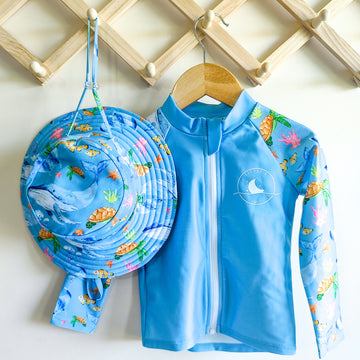
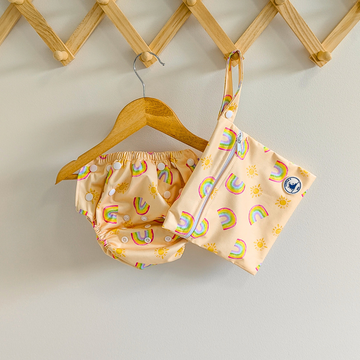
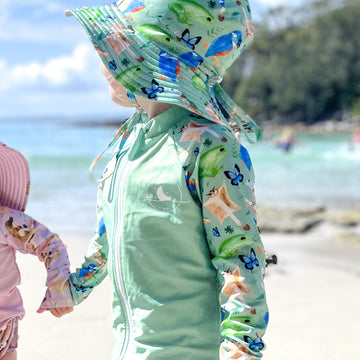

When you're packing for a family swim, picking out a cute swimsuit for your child might seem like a simple matter of style. But did you know that the colour of their swimwear could actually play a critical role in their safety?
While we often focus on flotation devices and sunscreen, the visibility of your child’s swimsuit is a layer of protection that often gets overlooked.
The "best" colour choice actually depends entirely on where you are swimming. A suit that stands out in a swimming pool might disappear in a lake. Combined with vital supervision guidelines, understanding swimwear visibility can significantly enhance your child's protection around water.
Here is a deep dive into the science of visibility to help you make the right choice for your next swim.
The Science of Visibility: Why Environment Matters
To understand why colour is a safety tool, we have to look at how water interacts with light. Water acts as a filter, absorbing light and drastically changing how colours appear.
A colour that looks vibrant on the sand might vanish the moment it’s a few inches under the surface. This is because water distorts and desaturates colour. As a parent, you want contrast. You need a colour that fights against the filtering effect of the water they are swimming in so you can spot your child instantly.
1. In Swimming Pools
The Environment: Most pools have light-coloured bottoms, usually white or light blue tiles.
The Strategy: You need colours that offer the sharpest contrast against the clear, blue water.
- Best Choices: Pink, Orange, Yellow, and Purple.
- Why: These colours do not exist naturally in a pool setting, offering the sharpest contrast against a light blue background.
2. In Open Water
This is where it gets interesting! "Open water" isn't a single category; the visibility of swimwear changes drastically between the coast and the country.
Ocean Water
The Environment: Ocean water often has a blue or turquoise tint. Because saltwater is frequently clearer than lake water, the biggest visual enemies are "natural" white disturbances.
The Danger of White: In the ocean, white and light grey can look exactly like sun reflections on the surface or sea foam from breaking waves. If a child is wearing white, they are effectively camouflaged by the surf.
- Best Choices: Pink, Green, Orange, Yellow, and Purple.

Lakes, Creeks, and Rivers
The Environment: Inland waterways are a different beast entirely. These waters often contain tannins (which turn the water a tea-brown) or algae (which turn it green).
The Strategy: Because the water is darker and "earthier," you need colours that can cut through the gloom.
- Best Choices: Orange, Yellow, Purple, Blue and Green (depending on the amount of algae).
- Note: Unlike in pools, Blue can work in certain inland waters depending on the shade and contrast against brown water, but bright neon options remain superior.

💡 Pro Tip: The Universal Winners
If you want one "universal" safety colour that works generally well across almost all environments from the backyard pool to the murky creek, Yellow and Orange are the clear winners.
Supervision is Key
While swimwear colour is an important layer of protection, it can never replace active, constant supervision. A bright swimsuit buys you seconds of visual reaction time, but supervision prevents the emergency in the first place.
Australia Swim Safety Guidelines, provide essential advise on how close you should be to your children based on their age:
Under 5 Years and Non-Swimmers: Within Arm's Reach
For this age group, visual supervision isn't enough. You should be in the water with them, close enough to reach out and touch them at all times.
5 – 10 Years: Constant Visual
You must have eyes on them at all times. If you aren't close enough to respond instantly, you're too far away. This means no scrolling on phones or reading books while they are in the water.
Over 10 Years: Active Oversight
Ensure they swim in supervised areas (like between the flags at the beach) and always use the buddy system. Even strong swimmers need oversight.
Making the Right Choice
By choosing high-visibility colours, you give yourself those extra few seconds that are so vital in an emergency. It helps you track your child in a crowded pool and spot them instantly if they slip under the surface.
However, remember that no swimsuit colour is a "set and forget" safety device.
- Always supervise children.
- Teach your kids to swim.
- Learn CPR.
Next time you shop for swimwear, keep the environment in mind. Style is fun, but safety is non-negotiable.


